Flexible Cell Printing & Packaging
1) Flexible Cells
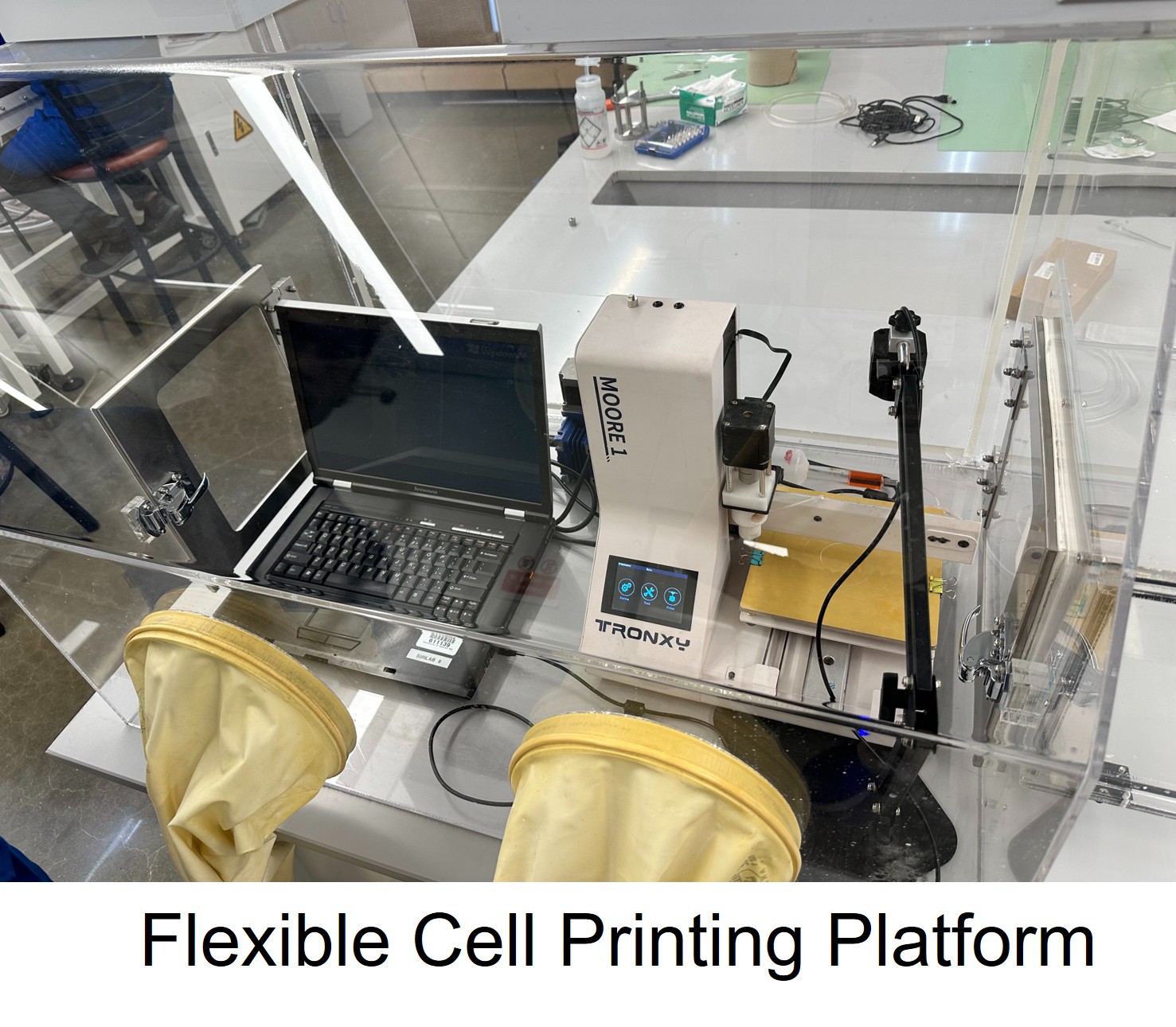
We develop flexible electrochemical cells through slurry-based 3D printing, a manufacturing approach that enables programmable control over cell geometry, architecture, and material placement. This direction moves beyond the rigid, planar design constraints of conventional batteries by allowing energy storage devices to be fabricated in mechanically compliant and shape-adaptive formats. Our research focuses on integrating printable electrode and electrolyte chemistries with manufacturing-aware design to create cells that can conform to nontraditional surfaces while maintaining electrochemical functionality and structural integrity. By leveraging slurry 3D printing as both a fabrication tool and a design framework, we aim to establish flexible cells as a new class of energy storage building blocks for wearable, robotic, and other systems operating under dynamic mechanical constraints.
2) Pliable Battery Packaging
We are developing pliable battery packaging as a new class of intelligent, adaptive protection for next-generation energy storage systems. Instead of treating packaging as a passive wrapper, our work redefines it as a functional interface between the battery and its operating environment. This interface is designed to conform to complex geometries, preserve chemical and environmental protection, and support resilient operation under mechanically demanding and unpredictable conditions. Our broader goal is to enable packaging that not only protects, but also expands how batteries can be deployed, integrated, and maintained in shape-adaptive platforms. This direction is motivated by emerging needs in wearable systems, robotics, aerospace, and defense, where conventional rigid or bag-like enclosures increasingly limit performance and adaptability. In the long term, we envision pliable packaging as a foundational technology for energy platforms that must be lighter, more field-tolerant, and more responsive to changing use scenarios than today’s battery architectures allow.